
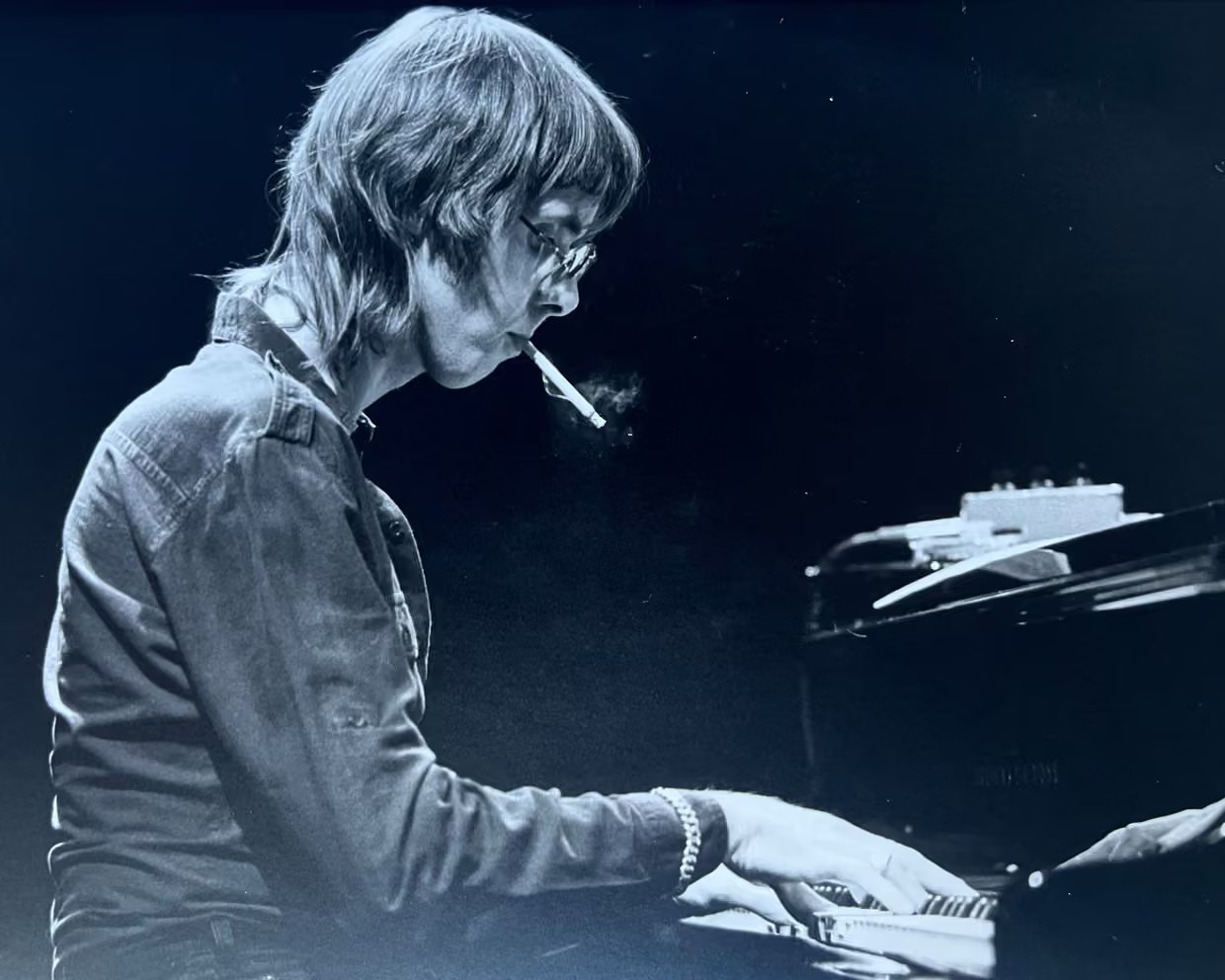
(Photo by M. Becker)
Something akin to a gifted script doctor or screenplay virtuoso in the mediums of film and television, it is the session musician who seems disproportionately unsung in the integral contributions made in adding flair and texture to classic records loved the world over. Perhaps no other man-for-hire instrumentalist embodies this more than Nicky Hopkins, a wizardly piano player who claimed what this film describes to be something of a “grand slam” in collaborating with The Kinks, The Who, The Rolling Stones and The Beatles. Indeed, between John Lennon’s Imagine in 1971 through to Paul McCartney’s Flowers in the Dirt in 1989, he also achieved a full set in performing on records by all four solo Beatles.
Directed by Michael Treen (mainly known for TV shows Primeval and Utopia), and clocking in at just under 90 minutes, this documentary takes its title from a Kinks song that Hopkins not only played on but was perhaps the inspiration for. Hopkins’ training at the Royal Academy of Music combined with his discovery of rock and roll as a teenager to create a uniquely redoubtable hybrid – part Jerry Lee Lewis, part Chopin – who peppered classical finesse and dexterity atop myriad stylings from rock to gospel to the blues. Over a thirty year period which encompassed the golden age of rock music, Hopkins appeared on over 250 albums, and thus proved to be one of its most prolific and respected players.
Narrated by ‘Whispering’ Bob Harris, and featuring talking heads from the likes of Keith Richards, Harry Shearer and Dave Davies, this film is – quite happily – almost exclusively about the music. Systematically and chronologically we are taken through Hopkin’s vast array of collaborations, each section of the film bookended with title cards, first denoting the artists and then a listed discography of which of their albums he performed on. Much is made of how this white man – who was born in Middlesex, England – could play with the soulful elan of a black guy from the Mississippi. It seems that it was not only for his virtuosity as a pianist but for his quiet humility as a human, that Hopkins prevailed as such a go-to session master. Egoless in the egocentric world of rock stardom, he no doubt offered up the appealing dual promise of outstanding overdubs and minimal fuss.
A challenge of this film lies in the fact that, in keeping with the man’s under-the-radar modesty, there is scant material of Hopkins either performing or speaking to camera. This is compensated for, effectively enough, with piano playing talking heads – primarily from Tom Jones’ pianist Paddy Miller – where we see the up-close replication of some of Hopkins’ iconic contributions. However, we do get access to some live footage: From John Cippolini’s tribute concert in 1989, a performance with Graham Parker and the Rumour in Germany, and from The Tonight Show with Johnny Carson when he provided backing for Art Garfunkel in the 1970s. Both interview clips of Hopkins are fuzzy relics from 1991 – like VHS tapes with the tracking out of kilter – but they do at least confirm Hopkins as the normal, unassuming bloke the film describes him as.
The decision to focus almost solely on Hopkins’ musical contributions is likely a wise one, creatively. Existing very much at the periphery to rock music’s weirdest and wildest characters, Hopkins is perhaps only known to the real music-heads of the era, and one wonders – given the man’s musical focus and touted niceness – if there would be much of a story to tell, anyway. However, the film does makes clear at multiple points how Hopkins’ diagnosis of Crohn’s Disease as a young adult plagued him for much of his life, and was a significant factor in his engendering a drug and alcohol habit that led to addiction and rehab in later years. Even with Hopkins’ drink and drug abuse, it seems that – rather than a product of debauched hedonism – it was a habitual salve as an attempt to assuage the pain of his condition.
Unfortunately, Crohn’s Disease bestowed upon Hopkins a frail constitution that was ill-equipped to cope with the physical rigours of touring and addiction, and his death at just fifty years old begs the question as to how much magic Hopkins’ fingers would have continued to sprinkle over the mid-90s and beyond. The only moment in the film where Hopkins is shown to display anything hubristic is in the fact he seems to have taken his own claim of being the reincarnation of Chopin quite seriously. The fact that many of the contributors here are quite willing to believe it speaks volumes as to Hopkins’ spellbinding role in the shadows of rock history.
On digital 4 May from Reel2Reel Films
Scott Hammond
