
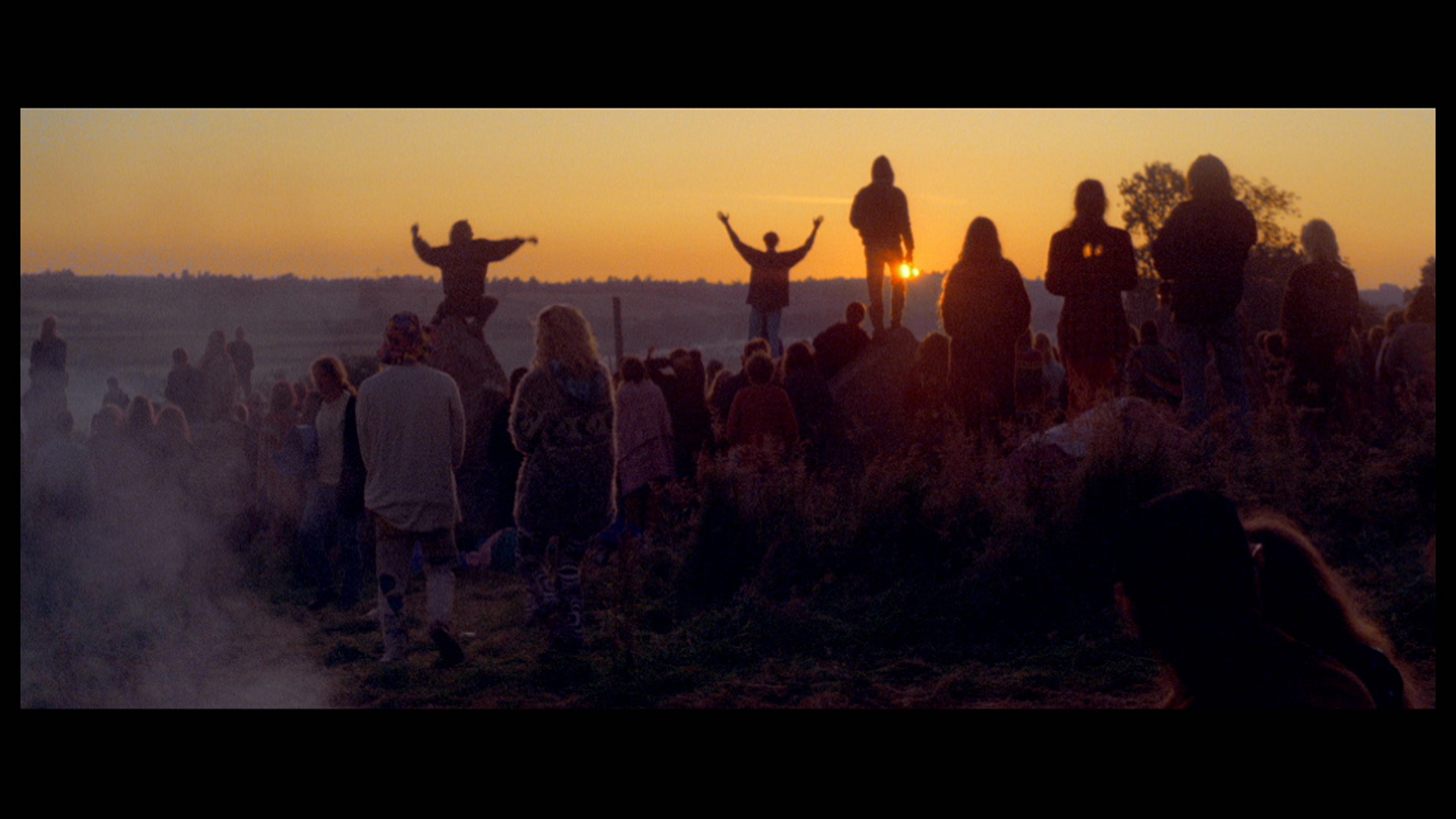
Celebrating the 30th anniversary since it’s original release in 1996, this 87 minute documentary serves as a fascinating period piece of a time when the Glastonbury Festival was at the tail end of its analog form, still existing, mainly, as a musical mecca for crusties and party-heads. Squarely in the liminal space between its origins as loss-making hippie hangout and the more corporatised behemoth to come, Glastonbury: The Movie – which documents the festival in 1993 – is a compelling keepsake of a bygone age.
Though this anniversary version is given the modern furnishings of a 4K restoration, pimped up Dolby sound and a wider frame, it’s surprising – even given the passing of three decades – that the footage therein looks so much like a relic from the past. It’s now, of course, the equivalent of those of us who were alive – or at least sentient enough – in the 1990s, surveying footage from the 1960s. And it feels quite a bit like it; we see a gentleman attempting to flog “exotic” vegetarian pizzas at £1.50 each, a Cockney carnival barker trying to hawk pairs of shorts for £2, and another chancer attempting to pass off a simple Magic Eye painting (all the rage in the mid-90s) as a manifestation of “an altered state of mind.” And there are no mobile phones, of course – surely the most notable difference if one were watching equivalent footage from, say, the last two decades.
The multipronged directorial unit (though this refurbed anniversary project was mainly fronted by Robin Mahoney) employ a loosey-goosey approach, the camera meandering around the festival, it floating back and forth between artists on stage and various goings on at the fringes. Occasionally, we get a glorious panning shot of the site which – even in its more modestly attended 90s form – astounds with its impressive scale. Overheard conversations from punters are captured on the mic and survive here as soundbites. There’s an amusing moment wherein a reveller’s complaint about “Too many dodgy dealers selling really crap stuff” incites his pal into a Python-like riff about “lark’s vomit” and “pigs bladders.”
At the periphery of festivities, we see folks setting up tents, festival staff gathering wood and maintaining the site, amateur musicians jamming by parked cars, the adhoc contingencies for showering and brushing teeth. The off-stage footage posits a positively carnival-like, but quaint, atmosphere, and it would be interesting to ask a contemporary Glastonbury-goer how much of that vibe survives into the present day; we see a busker singing Buddy Holly songs and playing the harmonica while upside down, a unicyclist, a couple of jugglers, and a Frenchmen who, curiously, has the hybrid vocation of portrait artist and ventriloquist.
Despite the freewheeling (almost a fly-on-the-festival wall) approach, the film offers some structure in partitioning itself into chapters denoting the Friday, Saturday and Sunday of 93’s festival. Its approach is one of attempting to capture the “real” festival, purposefully veering away from the Pyramid Stage and any of the headline acts. In fact, when the camera does focus itself on one of the stages, the artists are often so obscure (certainly 33 years hence they are) that one laments the fact that, with no explanatory captions forthcoming, one has to wait until the “you have been watching” end credits for clarification.
The stage performances are frequently presented in split screen, one half focussing on the band, the other on the crowd and activities around the site. Notable, to me at least, are The Lemonheads, with Evan Dando at his zenith as pop-punk heartthrob (it was a year when People Magazine named him as one of the “50 Most Beautiful People in the World”); an incredibly fresh-faced and gangly Richard Ashcroft as The Verve deliver ‘Gravity Grave’; ‘Stereo MC’s performing the previous year’s Top 20 hit ‘Connected’ and Omar’s rather lovely ‘Nothing Like This’. Of the bands outside of my radar, Porno For Pyros create a striking impression, certainly when a female stage-performer, in scanty stripper regalia, makes rather phallic use of a fire-eating torch.
Though the festival has grown into an increasingly rote pilgrimage of the populace, one suspects that even a modern audience would struggle to garner such variability in answering the film’s question “What is the festival all about?” A segment of vox-pops from these 90s revellers offer up responses as diverse as “Purpose in life” and “beer and acid”, “inner peace” and “getting off your face.”
The part of the film where an activist laments the ticket price of £58 while stating his ideal of a free festival future is, in its lack of prescience, perhaps its most poignant. It was all heading in the other direction of course, but here is a memorial – before the arrival of the BBC, before phone masts, biometric tickets and wall-to-wall coverage – to a beloved festival in its old school incarnation.
Scott Hammond
