
What I had anticipated being a raunchy, sex-positive, British comedy ended up being a romantic fable of heartfelt and poignant quality; a timeless parable about gender roles, possession, and what “true love” really is. Packed with euphemisms and profanity, and held up by a superb ensemble, Wicker was thoroughly enjoyable. Co-directed and written by Alex Huston Fisher and Eleanor Willson, it is based on the 14-page short story “The Wicker Husband” by British writer Ursula Wills-Jones.
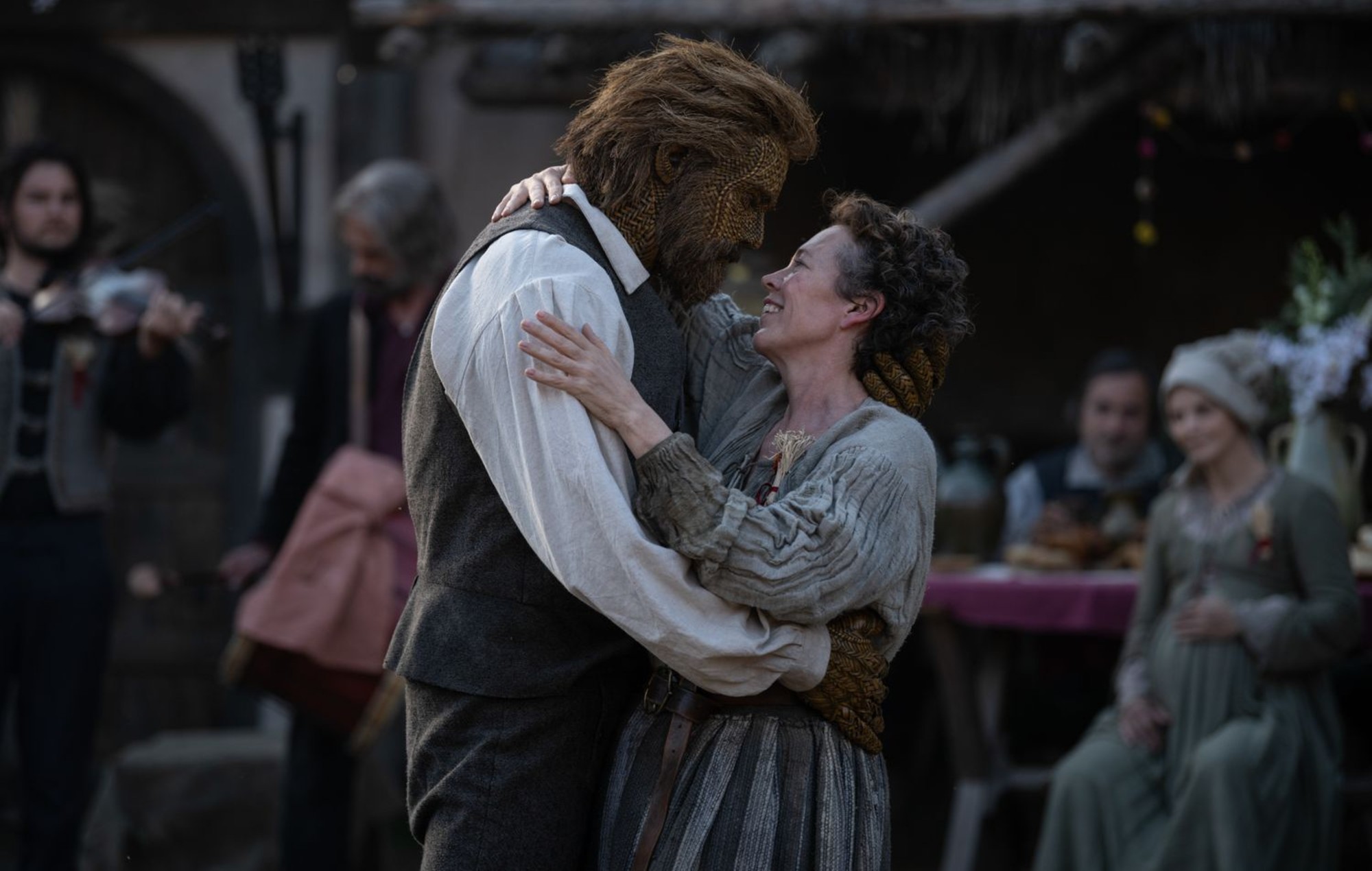
Wicker becomes a fascinating prism through which various different conclusions and lessons can be extracted, as with any of the best fables. The story at its core, however, is one of relationships and possession. The town in Wicker is incredibly patriarchal, with women having a collar clasped around their necks whenever they are married. However, this possessiveness extends to and poisons the populace as a whole, with jealousies arising from women and men alike when they see how at peace and in joy the Fisherwoman (Colman) and the Wicker-man (Alexander Skarsgård) are. The villagers are appalled when, during a village dance, the two blissfully dance to their own tune, shrugging off the structures of “how things must be done.” The comedy throughout comes from much of the village coveting the relationship, but more for its material benefits than its emotional ones. The Wicker-man is a tireless lover and one who is keen to help around the house: fix the roof, tend to the fish traps, and wash clothes. The men at the tavern are taken aback when they ask why he does things and his answer is “because it makes her happy,” something that lands as an inconceivable notion to them.
To film a fable is to embark on a delicate dance. None of the characters have names; they are always referred to by their professions. It is a sign that characters must serve as stand-ins and symbols, but one must also be able to provide them with enough depth to make them distinct and complex. Huston Fischer and Wilson achieve such a feat, largely thanks to a balanced tone that knows when to use comedy and when to pull back and let a scene breathe. They are also aided by a spectacular cast. Colman is indomitable and domineering in her command of her craft, in every small gesture, pout, or eye flick; she is a delight to behold in her element. Skarsgård has a doubly hard task, not only having to bring a Frankenstein’s monster type of worldly naiveté to the role, but also to imbue his every body movement as if he were a restricted being made of wicker, who can only move his limbs and face in limited ways. Elizabeth Debicki, as the Tailor’s Wife could have easily fallen into a clichéd mean girl role, but instead gives her character a complexity and a background of frustrated ambition that fuels her menace. It is Peter Dinklage’s Basket Weaver, however, who is a standout, though essentially a bit part, but one in which he delivers Shakespearean soliloquies, deliberating about whether to create life or not. His relish at each word, delivery with such panache, and command of the screen are absolutely hypnotic.
Wicker is brought to life with an incredibly tangible quality, thanks to spectacular work from the production design team, which created the medieval town itself in such detailed fashion. But a special shoutout has to go to the make-up and special effects team, which bring the Wicker-man to life in astounding fashion. I simply didn’t know where the make-up ended and the CGI began, and was astounded to see how the sunlight peered through the gaps in the wicker stitching of his arms and face, how the hair was sewn to the wicker scalp, and even the musculature of his face, composed in such minuscule detail.
In the end, Wicker is a delightful fable film, with characters that serve both as useful stand-ins to project onto and as figures who develop their own complex arcs. The story itself is one rich for interpretation; I could certainly see parallels with Al emotional dependency, as a further example. It’s true that in its compact nature, certain character threads can’t be dug into as deeply, for fear of becoming too specific, and other characters remain caricatures without much depth, more the butt of a joke than anything else. Nevertheless, Wicker proves a delightful and stimulating watch, one that will deliver laughs and leave your mind whirring when you exit the theatre.
Ben Nixon
