
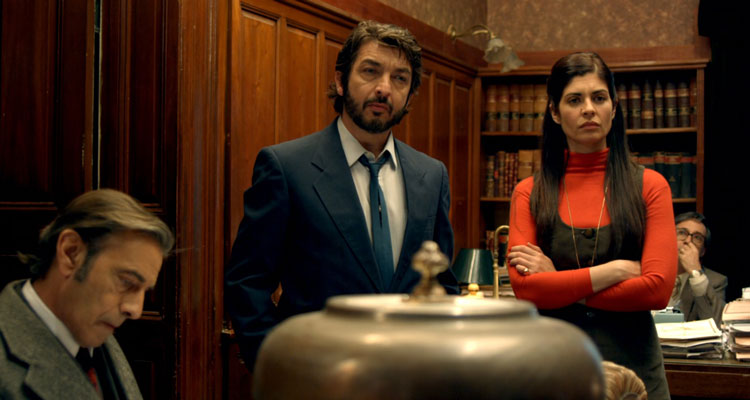
Juan José Campanella’s The Secret in Their Eyes (El secreto de sus ojos) is a gripping, twisty neo-noir thriller that gradually becomes a meditation on memory, class, political violence, and the emotional cost of unspoken love. Its mixture of romance, humour, and noir darkness makes it unusually absorbing: beneath the mystery is a man attempting to make sense of a life shaped by regret. Adapted from co-screenwriter Eduardo Sacheri’s 2005 novel, La pregunta de sus ojos, the film is a tortured tale of love lost, and a murder investigation revisited. Campanella directs with dexterity and flair, breathing sinewy cinematic life into Sacheri’s novel,
Retired prosecutor Benjamín Espósito begins writing a novel based on a brutal rape and murder he investigated in 1974, an unsolved murder case that still haunts him. Returning to the case also means returning to Irene Menéndez Hastings, his former superior and the woman he has loved for decades without confessing it. Campanella moves between past and present through nonlinear flashbacks, allowing the case to resurface piece by piece. This structure creates suspense while making memory feel unstable: Espósito is reconstructing events, but also revisiting the choices and silences that defined him. The film’s twists keep the narrative compelling, although its final revelation may strike some viewers as more grotesque than satisfying, trading the realism of an anticipated conclusion for a darker, almost theatrical shock.
The film’s setting is crucial to its noir atmosphere. The investigation unfolds against the political terror of 1970s Argentina, a time of “dirty war” turmoil, where the junta, disappearances, and institutional corruption make justice precarious, and criminal paranoia to become intertwined; both asking questions and finding answers are dangerous to even attempt. Campanella suggests that a society in which people are afraid to question the fate of the disappeared offers cover to private criminals as well as political violence. The historical context is not merely background; it deepens the film’s questions about who is protected, who is silenced and whether the law can be trusted to deliver justice. 2015 saw a star-studded English-speaking remake, Secret in Their Eyes, directed by Billy Ray, and starring Julia Roberts, Chiwetel Ejiofor, and Nicole Kidman. Ray’s take opportunistically tonally opts for America’s ‘war on terror’ to explain the more credibility-stretching turns of the narrative. It is widely regarded as inferior to Campanella’s original, lacking the intrigue, intelligence, and emotional tension of the original; with sentimentality that feels superficial, characters one-dimensional, and the relationships contrived and forced.
Campanella’s direction is often impressively controlled, but its boldest flourish is the football-stadium sequence. A seemingly continuous tracking shot sweeps from an aerial view into the claustrophobically passion-packed terraces, twisty corridors, and gloomy concourses, following a suspect through the crowd and into the stadium’s corridors, then returns to the pitch. The elaborate movement combines technical spectacle with narrative urgency, immersing the viewer in the chase. The fluid camera movement immerses the audience in the action, making the sequence both visually spectacular and narratively purposeful. The mise-en-scène, including the period settings, costumes, and warm colour palette, also establishes a convincing atmosphere, contrasting the characters’ personal struggles with the wider political instability of Argentina. The film’s pacing is generally assured, though its length and occasional coincidences can test credibility.
Sound is used with similar restraint. Campanella avoids excessive reliance on musical accompaniment, allowing silence and ambient sound to communicate unease. In quieter scenes, the absence of a soundtrack directs attention towards facial expressions, pauses and dialogue, intensifying the emotional atmosphere. This restraint is particularly effective in moments of suspense, where the audience becomes attentive to even the smallest movements. The editing also contributes to the film’s rhythm, moving between timelines without disrupting narrative coherence and allowing revelations to develop naturally. This understated approach heightens suspense and keeps the film from over-explaining its emotions.
The performances give the story its emotional weight. Regular Campanella confidant Ricardo Darín plays Espósito, with weary charisma, conveying professional frustration and private longing through restrained expressions and hesitant gestures. His love for Irene is complicated by a class divide: she is educated, socially assured, and his superior, while he is acutely conscious of his position. Pride and insecurity help explain why his feelings remain unspoken. Soledad Villamil makes Irene more than an idealised love interest, giving her intelligence, composure and vulnerability. Their chemistry is quiet and convincing, built around glances and unfinished conversations rather than declarations. Guillermo Francella’s Sandoval is equally important. His alcoholism, depression, and reckless denunciations of those in power make him both comic and tragic. His friendship with Espósito, expressed in practical acts of loyalty and care, provides a rare source of intimacy in the prosecutor’s lonely life. The humour surrounding Sandoval never entirely erases the sadness beneath it.
Thematically, the film explores the relationship between passion, justice, and revenge. The murder investigation exposes the limitations of the legal system and the influence of political corruption, suggesting that justice is not always determined by truth alone. The characters are driven by passions that shape their identities and decisions, sometimes providing purpose and sometimes becoming destructive. Campanella leaves the audience questioning whether revenge can offer closure or simply perpetuate suffering.
Ultimately, Espósito’s fixation on the murder is also a way of managing his own heartbreak. His pursuit of the case becomes a form of self-punishment and emotional displacement: it gives structure to a life in which he believes he has missed his chance at love. The Secret in Their Eyes is not flawless, and its ending may divide audiences, but its craft, performances and dark historical atmosphere make it an exceptionally compelling film. It lingers because it asks whether passion sustains us, or traps us in the past.
Juan José Campanella’s Academy Award winning The Secret in Their Eyes arrives Limited Edition 4K UHD/Blu-ray on 23 November 2026 from Second Sight Films, alongside Standard Editions. Visit here for more info.
Ben Nixon
