
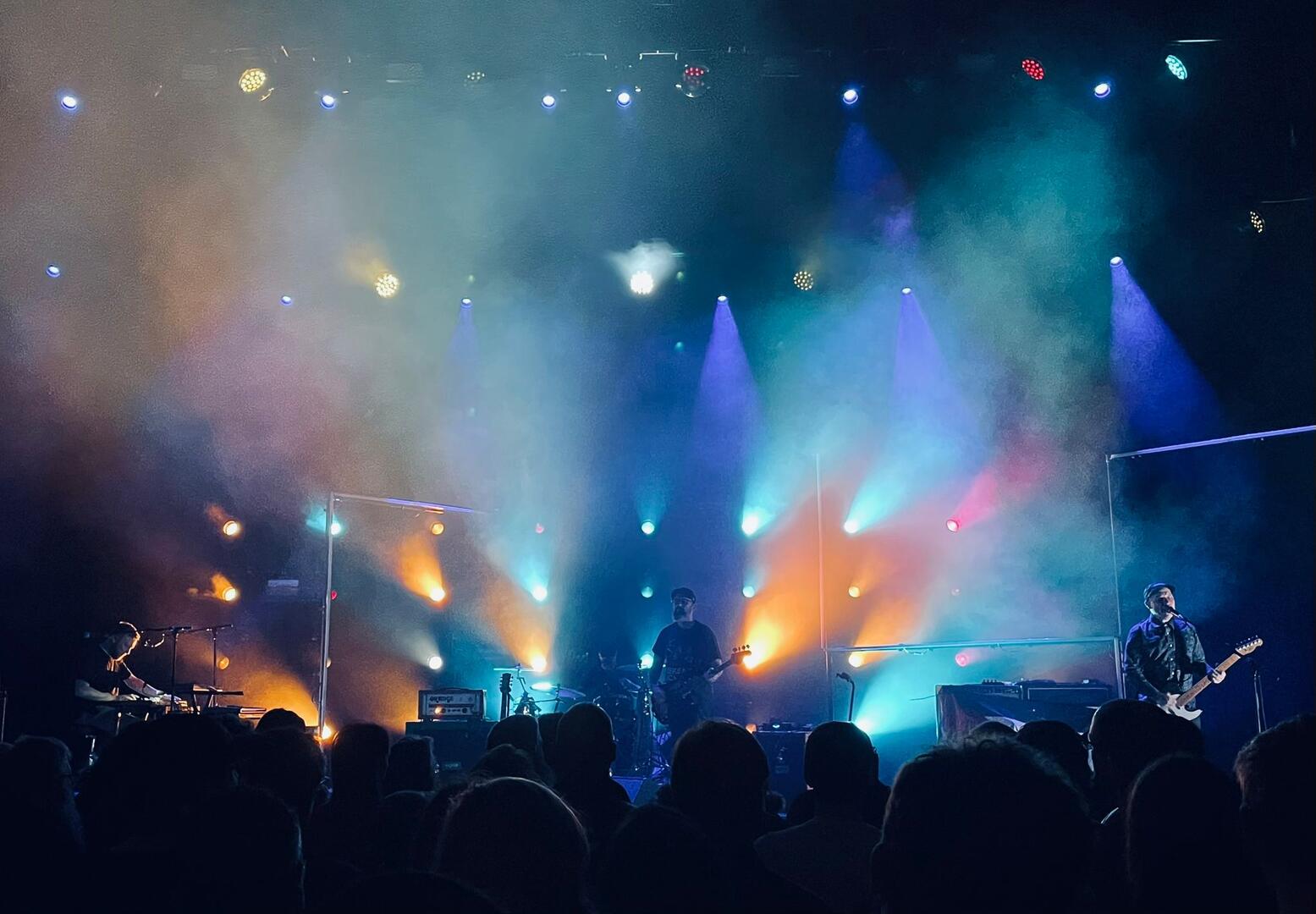
It’s been 28 years since Mogwai released their first album, the ferocious Mogwai Young Team, and just over 30 years since they formed. Though they have consistently flown slightly under the radar, the Glaswegian post-rockers have quietly built one of the most devoted cult followings in modern guitar music. They were, after all, somewhat of a rebuttal to Britpop’s chart-bothering bravado in the late 1990’s, offering blissful and epic instrumental soundscapes reaching for something higher. As the narrator on the debut’s ‘Yes! I Am A Long Way from Home’ proposes, their music could “put a human being in a trance-like state”. Alongside contemporaries such as Godspeed You! Black Emperor and Explosions in the Sky, Mogwai build music intended for total immersion.
This reviewer – who only came to exist in the 2000s – discovered the band retrospectively, long after those first few essential records. At the sold-out Beacon tonight, I’m surrounded by greying band tees worn by long-term fans who’ve been carrying these songs with them for decades. But this generational gap is only a testament to the band’s longevity and lasting influence. Then again, it might just be the mark of a devoted Sunday night crowd.
The band arrive on stage with limited fanfare. After a short introduction from vocalist Stuart Braithwaite (“Hi, we’re Mogwai from Glasgow, thank you for having us”), a synth arpeggio signposts the start of ‘God Gets You Back’, the first song on the excellent, transcendent new album The Bad Fire. It is a slow build, as the synth is gradually met with soft bass, guitar, and a gentle ride. Eventually, the song shifts to a steady beat built on power chords and idiosyncratic vocals (“Count the roads, Dallas eyes, Don’t breathe rare air”). It is gentle and lush, before building into a euphoric finale.
Next up is ‘Hi Chaos’, an instrumental piece that transitions between a soft guitar riff and crushing, decibel-breaking overdrive. Just when I think it can’t get any louder, guitarists Barry Burns and Dominic Aitchinson take it up a few notches, leading to an extended coda of breathtaking noise. Soon after, set highlight ‘Drive the Nail’ (from 2021’s As The Love Continues) raises the stakes even higher. The seven plus minute track is essentially split into two sections of slowly layering guitar chords and increasingly erratic drums. When it breaks out into its two explosive climaxes, it is almost overwhelmingly loud. I feel my whole-body pulsing with the drums and guitar, fully immersed in the sound and nothing else.
And Mogwai are truly, very loud. So much so that, in 2020, Kerrang! Magazine listed them in the 15 loudest bands in the world: “People claim that during Mogwai festival appearances moths and insects near the speakers were literally blown to pieces when the loud parts arrived”. But, though many sections are extraordinarily loud, Mogwai’s set is dynamically well-balanced. Later in the set, songs like ‘Pale Vegan Hip Pain’ (if you mind the title) provide some needed respite from the whirlwinds of noise. Here, a lovely guitar melody is met with washy, atmospheric synths. It is a beautiful, sentimental track, and a perfect showcase of Mogwai’s ability to create dreamy and transcendent soundscapes.
Moving to the latter half of the main set, the band knuckle down with some straightforward rockers. Though I have already described Mogwai as a post-rock band, in a way this is only half-true. ‘Ritchie Sacramento’ displays a conventional song structure, with a clearly definable verse, chorus, and bridge. There are also lyrics! Heard outside of the Mogwai canon, this song would be best described as shoegaze-y rock, like Slowdive but with a motorik beat and power chords.
‘We’re No Here’ is similarly heavy, but more doom-laden. The crunchy chords shake the soundsystem and, by extension, the (refreshingly phone-free) audience. Ending the main set is ‘Lion Rumpus’, a short and versatile rock tune, featuring vocoder vocals and screaming guitars. Though the punishing volume serves to support many of the longer, more ethereal songs, it occasionally obstructs the more meat and potatoes tracks. The drums and vocals are a little lost in the mix, the guitar taking precedence over them. As a result, it sounds a tad messy, and doesn’t pack quite the same punch. I also can’t say I’m entirely on board with the vocoder.
The band return for an encore of two extended, older tracks. First is the gorgeous ‘May Nothing but Happiness Come Through Your Door’ from 1999’s Come on Die Young. It is soft but expansive, very reminiscent of Sigur Rós’ seminal Ágætis Byrjun of the same year. Finishing off the evening is ‘Mogwai Fear Satan’, an epic, 16-minute instrumental journey from the debut album. Though Stuart Braithwaite tackles some technical issues with his guitar through the first third, these are eventually sorted for the song’s defining moment.
Around the seven minute mark, after a long passage of quiet, rolling toms, and gently plucked guitars, the song suddenly breaks out into inexplicable, mind-boggling noise. It completely takes my breath away, and consumes the entire room. As the lights turn back up, I overhear a conversation next to me: A man says “wow, what did you think of that”, and his friend replies “absolutely fantastic. Could’ve been louder though”. I get the sense he’s only half-joking
Conor Lang
