
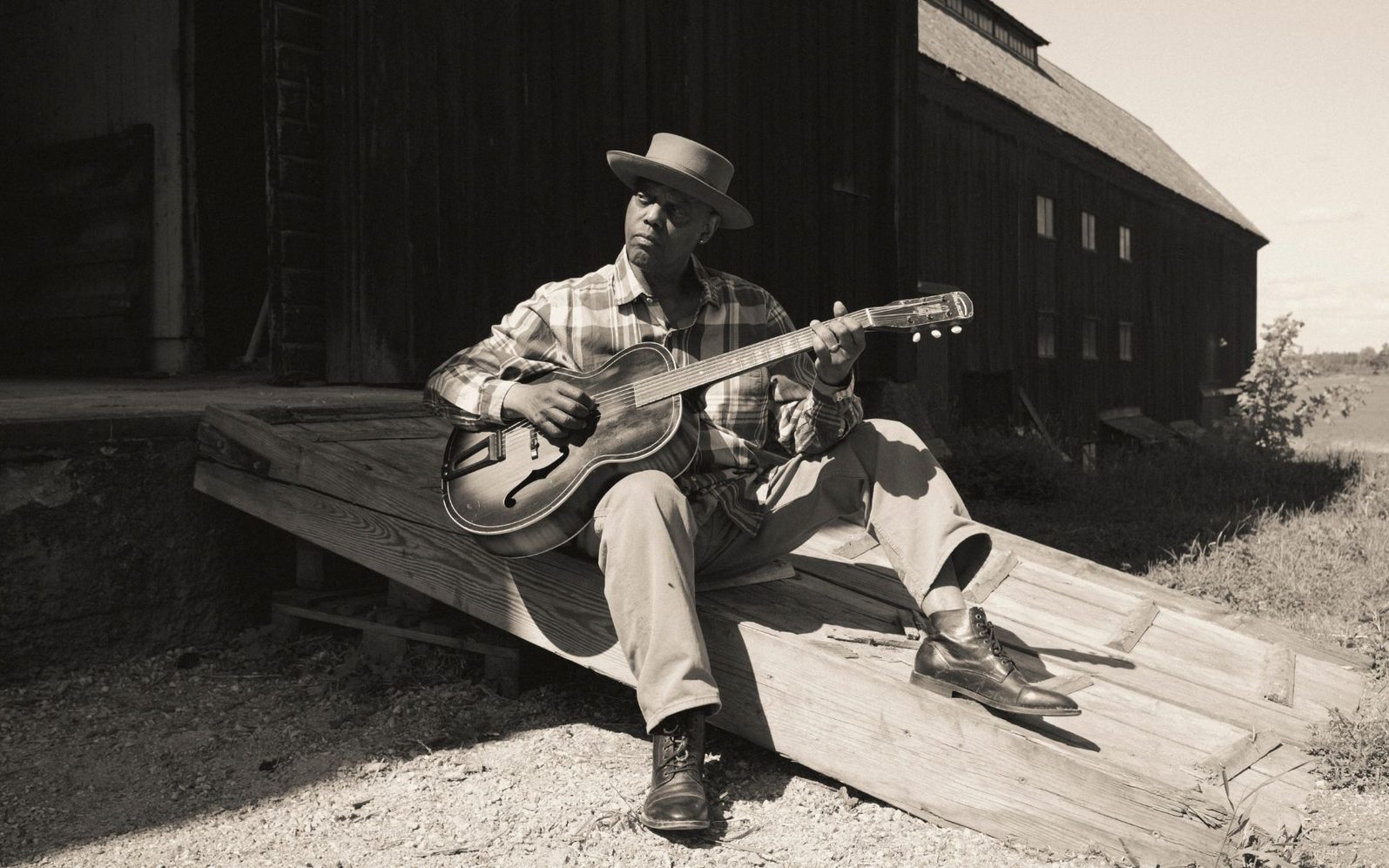
Eric Bibb, 74, ambles onto the stage in Bristol Beacon’s Lantern room. His trademark wide brimmed hat casts shadow over his face as a single spotlight illuminates this one man and his guitar. He begins to pluck out the classic blues riff of Goin’ Down Slow, a performer entirely confident in his well-earned craft. A New York bluesman inspired by the Village scene of the 1960s, Bibb has spent almost 6 decades fine-tuning said craft. His bedding in roots music was propelled by a move to Scandinavia, and he continues to pull on threads from Delta blues, folk, gospel and soul.
The supposed simplicity of the introductory song highlights Bibb’s fine baritone voice and deep footing in the blues. It also brings into focus his dedication to the musicians that have gone before him. He collaborated with Taj Mahal, one of his major influences, on the original recording of Goin’ Down Slow and goes on to pay tribute to several more of his “heroes and sheroes.” Once the rest of the four-piece band is on stage, he starts with One Mississippi from his new album of the same name, a song written by Bibb’s “high school classmate” Janis Ian. While Ian’s version was stripped back and raw, Bibb’s band bring together polished textures to fill the song out.
It is worth mentioning the high quality of the musicianship on stage. The rhythm section of Glenn Scott (bass and “musical director”) and Paul Robinson (drums) are superbly tasteful, with Robinson in particular keeping things together in the most minimal way, rarely deviating from the use of brushes or the palms of his hand. This, along with the high class of the Lantern’s sound system, make it feel like the gig could be taking place in your own living room. Second guitarist Robbie McIntosh, meanwhile, plays beautifully alongside Bibb, utilising deft soloing and complementary licks. His Knopfler-esque slide interventions elevate Along the Way, a song Bibb wrote for his children.
Speaking of children, it is clear that Bibb is a loving family man. He speaks kindly of his wife Ulrika Bibb before bringing her up on stage to duet on several songs, including Dance Me to the End of Love, a romantic song with an amusing backstory. Bibb saw the Jack Vettriano painting of the same name, and thought it would make a great song. He didn’t realise, of course, that Leonard Cohen had already released a not insignificant track of that name, which indeed originally inspired the painting. Never mind, Bibb did his own version, and the performance between him and Ulrika is touching, with an underlying melody reminiscent of Love in Vain.
More tributes come along. The band soars through Garrick Davis’ I Belong to the Band and Lead Belly’s Alabama Bound. Bibb makes an affable host, joking around when his guitars go out of tune. He explains that Send Us Brighter Days, a song he wrote with Malian musician Habib Koité, features a verse in French, “in case that isn’t readily apparent.” For a cover of Walter Davis’ Come Back Baby, he laments that “when a man starts hollerin’ ‘come back baby’, you know it’s already too late.”
Bibb begins to round off the set with a communally-sung Needed Time and the romantic Saucer and Cup, before finally standing out of his chair for his “Elvis Moment” and a rockier doublet to finish things off. The assuredly straightforward This One Don’t picks fun at it’s own simplicity – “some songs got complicated melodies, this one don’t”, while crowd-pleaser My Father’s House closes down the show. It’s a fine way to end things, although it was in the tasteful textures of the first 90% of the show that Bibb and band showed their mastery of their craft.
