
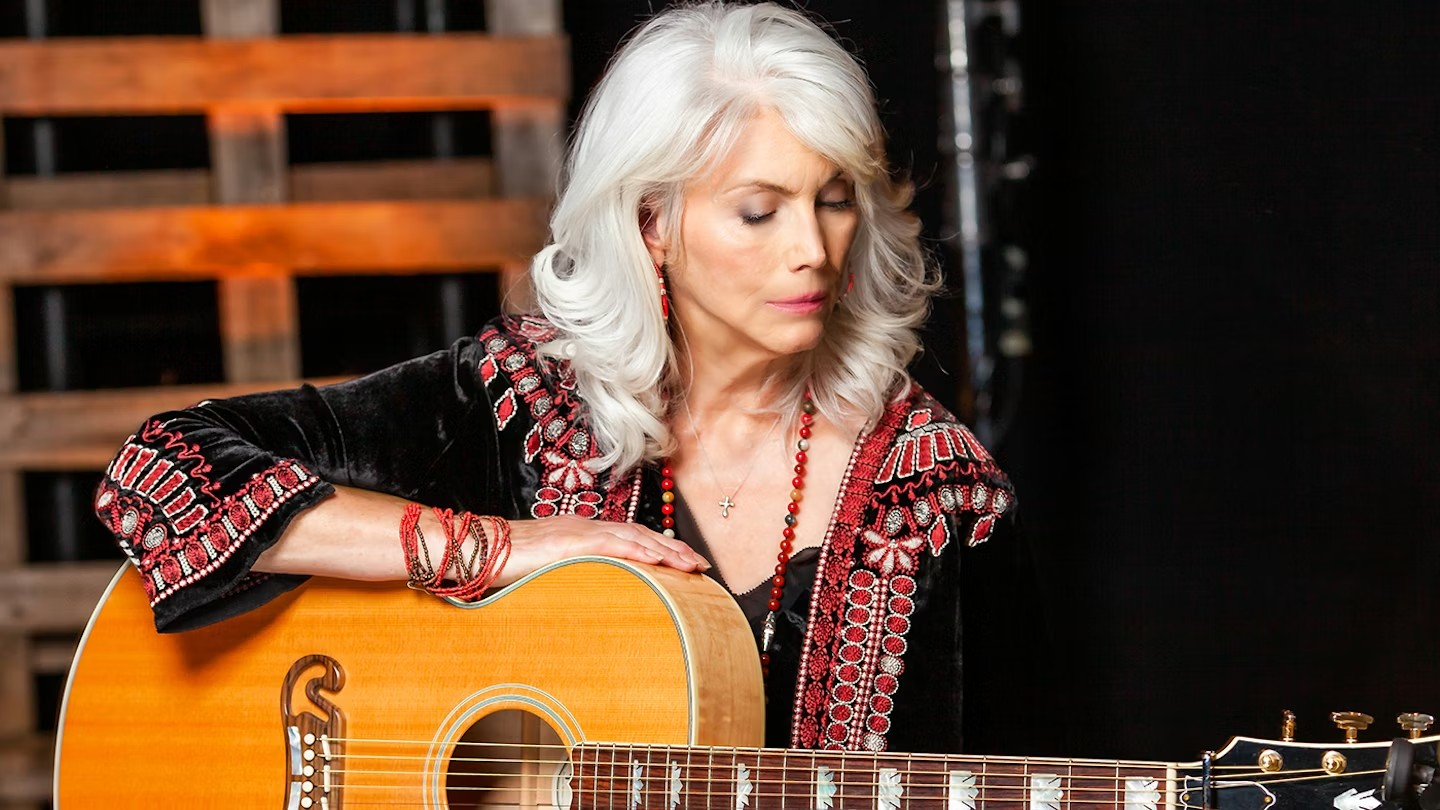
As a struggling singer in the 1960s, Emmylou Harris befriended one Gram Parson amidst Washington D.C’s bustling folk scene. Soon after, in 1973 and ’74 respectively, her unique vocal talents adorned Parson’s landmark albums GP and Grievous Angel and it proved to be the career breakthrough she’d been searching for. Thus, it’s been just over fifty years since Harris – who, as much as anyone, can lay a convincing claim as the Queen of Americana – began touring as a professional artist. This current European Farewell Tour marks both that milestone and a much-celebrated career. Tonight, then, represents one of those rare opportunities to bear witness to a living musical legend.
Harris, wearing a black dress that further illuminates the already striking brightness of her silver hair, immediately invites support act Jim Lauderdale to duet for the opening song. There’s an audible communal gasp from the audience – one that didn’t quite anticipate such instant loveliness – when Harris sings the opening line of the Everly Brothers’ ‘Love Hurts.’ Harris’ band – a slightly morphing line up of guitar, keyboard/accordian, double bass, drums and mandolin/fiddle – then stroll into view and join for the second verse.
Once settled in, it’s during Harris’ 2003 self-penned tune ‘Here I Am’ and accordion-laden Gillian Welch song ‘Orphan Girl’ that one notices just how strong Harris’ vocals remain at 79 years of age. As acknowledged a couple of times throughout the evening, Harris is primarily an interpreter of other people’s songs, so it is largely a reverence for the characteristic prettiness of her voice that has made her such a beloved figure. Although there are a couple of moments if one were really looking to nitpick – such as her not quite landing as graceful a falsetto as would her younger self during ‘Hickory Wind’ – it’s no less than astounding that, at the end of its eight decade, that voice has remained so impressively unscathed.
There is something homely and familial about Harris, and this indeed informs some of her song choices and crowd interactions. She describes how Kimmie Rhodes’ ‘Love & Happiness’ – hitherto of the most purely Country vibe one would associate with Harris – evokes feelings toward her children and grandchildren. In introduction to George Jones’ lovely ‘One of These Days,’ she tells us that she spent 21 years living with her mother – partly, one presumes, to care for her in her dotage – and that apparently you’re never too old for a maternal admonishment to wear a bike helmet.
Harris is readily accepting of her relative lack of songwriting prowess – “writing songs is terrifying” she confesses – and a couple of times assures us that she “steals from the best.” In introduction to ‘Red Dirt Girl’, one of her own compositions, she describes discovering how her own happy childhood was heavily at odds to those she met at college, and alludes to somewhat inventing hardship for the song’s purposes. One wonders if there’s something revealing there; perhaps if Harris were more possessed of a certain dysfunction or darkness, songwriting might be a more profligate, less terrifying, process.
An artist as enduring and widely endorsed as Harris has two key attributes which imbue the live performance with such thrilling gravitas. Firstly, her age and achievements bring with it such a rich history that she can reel off stories such as her getting to know Townes Van Zandt in Greenwich Village in 1968. Later, she describes the 1980 concept album The Legend of Jesse James, which featured Levon Helm as the titular hero and Johnny Cash as Jesse’s brother. Secondly, her reputation assures that she can attract some of the finest musicians to back her. Harris’ band are, to a man, tight, dynamic and interested in serving the songs with economical, unshowy playing. Special mention should go to guitarist Will Cambro, who also provides effective vocal harmonies and, in the case of Van Zandt’s ‘If I Needed You’, shares a polished duet with Harris. Also, Eamon McLachlan (of South London stock we later hear) is excellent in switching between mandolin and fiddle; he blisteringly wields the former in the Bluegrass of ‘Get Up, John’, and the latter surges beautifully during Harris tune ‘Tulsa Queen.’
A highly enjoyable evening is, largely due to the mostly senior audience, made more so by the almost non-existent sighting of the dreaded smartphone. It’s also quite charming that, such is Harris’ commitment to her Gibson L-200 Jumbo acoustic guitar, her roadie ventures back and forth handing over copies of the same instrument throughout the show. And there’s great charm, even in the moments when there is perhaps a small glimmer of Harris’ age; when she forgets the lyrics going into the second verse of Merle Haggard’s ‘Kern River’, she merely declares “I’m 79, give me break”, and defiantly states her refusal to succumb to a teleprompter.
The term ‘farewell’, when applied to tours, can be a pliable one. On this evidence, Harris’ voice has the potential to run a lot further yet. However, should this tour be Harris’ bona fide curtain call on a glittering career, it’s been quite the honour to have witnessed it.
Scott Hammond
