
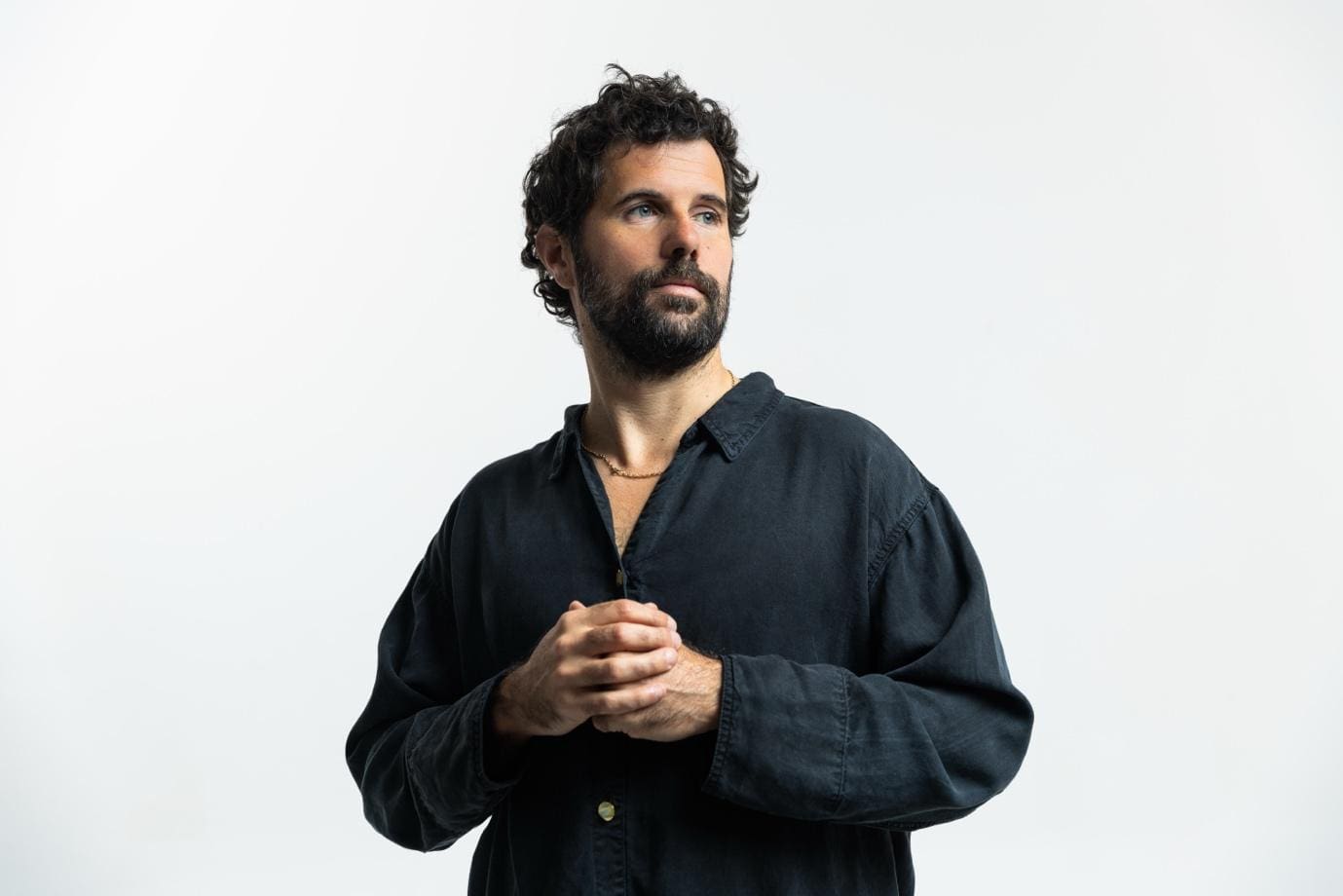
Singer-songwriter Nick Mulvey – jet black hair, pristine dark beard and clad in crisp, baggy blue shirt – is all smiles with arms aloft at tonight’s commencement of a brief run of four UK dates before heading to the European mainland. Mulvey, raised in Cambridge and of such worldly stock that he once lived in Cuba as a music and art student before returning to England to study Ethnomusicology, arrived as a much-lauded folk artist when debut album First Mind was nominated for a Mercury Prize in 2014.
Mulvey appears solo this evening, accompanied only with a selection of acoustic and electric guitars, and very occasionally some synthesised strings. The subtlety and restraint of this approach is immediately vulnerable to the loud murmur emanating from the back of the venue, as the opening chords to ‘Nothing Lasts Forever’ are submerged by the sound of chatter. Mulvey’s characteristically warm and soulful voice, however, is a powerful instrument that inspires the first of the night’s many singalongs.
A few moments later, it’s now Mulvey’s prerogative to speak over his songs as he declares “Bristol…it’s good to be back” atop the sprightly introductory chords of ‘Begin Again.’ Once more, the audience willingly offer themselves up as a backing choir. ‘Radical Tenderness’ features the simultaneously breezy but featherlight open hand strumming technique oft utilised by Mulvey, while ‘Dark Harvest’ – as evocatively tenebrous as its title would suggest – is delivered with an antithetical strumming that is both sparse and fractured.
‘Dark Harvest’ essentially serves at the title track of Mulvey’s two most recent albums – Parts 1 and 2 both being released in 2025 – and they represent a significant thematic shift toward his newfound Christianity. ‘A Prayer of my Own’ – featuring Mulvey morphing some neat fingerpicking into some sharp string bends – actually dates prior to his surrendering to Christ in 2023 and, thus, the signs to his eventual transition were perhaps always there.
These religious themes are more explicit in the sparsely lyrical ‘My Maker’ (“It’s a mad world, but our maker is good”) and Mulvey later shares us the quasi-philosophical sentiments of a friend: “God is strengthening us through weakening us.” This serves as the introduction to ‘Holy Days’, wherein Mulvey’s talents are considerable enough – albeit he prompts us with the song’s upcoming lyrics in advance – to incite a hearty singalong of spiritual redemption from, one assumes, a largely secular crowd.
Mulvey has an affable and likeable manner during the few conversational interludes. In declaring his admiration for Underworld’s 1995 hit ‘Born Slippy’, he amusingly describes once having the idea of performing an acoustic version but coming unstuck at the most likely ludicrous “Lager, lager, lager” refrain. However, he settled for the borrowing of a couple of chords and we hear the result in the form of ‘Unconditional.’
Rather than a songwriter who effortlessly spins instantly memorable melodies, Mulvey’s appeal lies in the crystal-clear warmth of his vocals, emotive weight of his lyricism, and his capturing a singalong quality in much of his work. ‘Mountain to Move’ – which features the well observed truism “We get lost in comparison” – is the first of a final sprint wherein the audience gets to flex their vocal cords. This perhaps reaches its anthemic acme with old favourite ‘Meet Me There.’
At the start of a two song encore, the babble of chattering that hasn’t quite subsided the entire evening, can clearly be heard once again at the semi-classical nylon string intro of ‘Find Me.’ It isn’t until the evening closes with his best-known track – ‘Fever to the Form’ – that Mulvey has achieved a state of pure attention amidst the 1000 plus audience. However, it’s a moment where one can observe enough arms-aloft celebration and heartfelt singing within the crowd to conclude the Mulvey, with only guitars for company, is more than enough.
Scott Hammond
