
Starring Oliver Reed and Vanessa Redgrave, this landmark historical drama explores religious hysteria, political corruption and institutional power. Esteemed as “one of the most controversial films of all time”, it is a hallucinatory and frenetic experience. Regarded as an authentically true account of 17th century France, The Devils is a cautionary tale of unholy marriage of church and state, based on the book by Aldous Huxley, and the John Whiting stage play. The reason for this longstanding controversy is the belief the film has a brainwashing nature, and the politicisation of the religious hysteria throughout, a performative pantomime of blasphemy: upon release several scenes were cut out due to their sensationalism, and it isn’t until recent years that a director’s cut restoration has been made available.
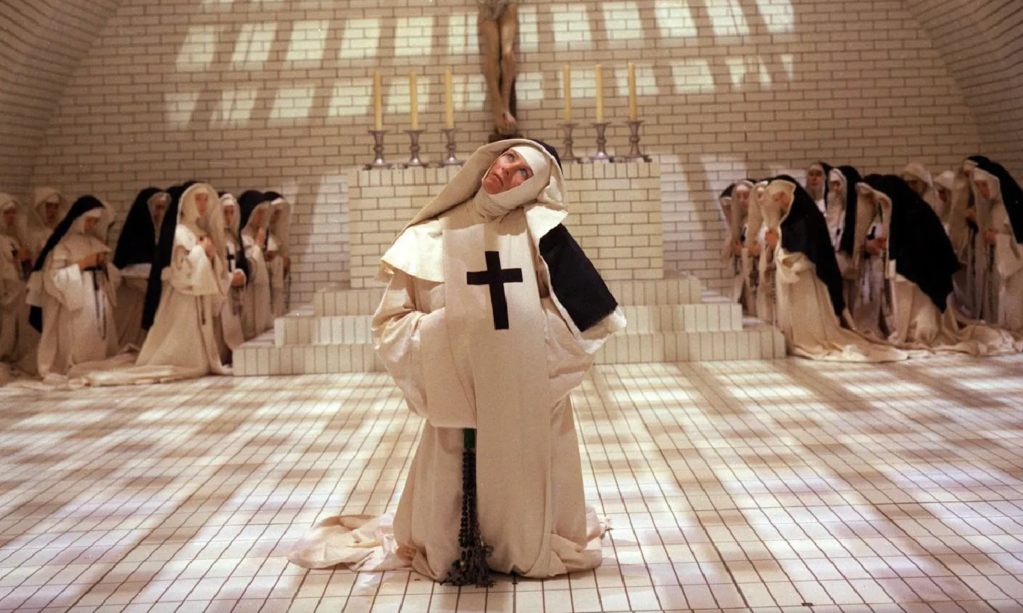
Derek Jarman’s neo-futurist design gives The Devils’ madness a divine scale, the film balances the debate between real spiritual enrichment versus the debasement of Christianity’s rituals. The sensationalism of the film could be polarising for many, as it has evidence of being for so many years, in its outrageousness and excessively blasphemous nature, it is most definitely bombastic and extravagant, but I appreciated the confidence and awareness of its own controversial nature. Peter Maxwell Davies’s soundtrack is equally cacophonous, almost avant-garde, but fitting of the style.
It’s a grandeur spectacle of career-best performances, also. Oliver Reed is marvellously visceral as Father Urbain Grandier, the charismatically admired priest who is met with controversy and disdain, with locals and those in power intending to knock down the city walls to take away it’s independence in the attempt to discredit Grandier, and to prevent Protestant uprisings. Equally prominently distinctive is Vanessa Redgrave’s Sister Jeanne, who is believed to be suffering from hysterical delusion; she claims to be a victim of sorcery, as does her convent of Ursuline nuns, who believe to be under the possession of Grandier.
Mark Kermode, an avid fan of Ken Russell’s classic, released a documentary in 2002 entitled Hell on Earth: The Desecration and Resurrection of The Devils, directed by Paul Joyce, which entailed the history, production, censorship and controversy surrounding the film. Hell on Earth featured interviews with Ken Russell, several cast members (Vanessa Redgrave, Georgina Hale, Murray Melvin, and Dudley Sutton) and editor Michael Bradshell. Kermode, and this documentary specifically, famously tracked down and re-examined the previously cut controversial sequences, such as the “Rape of Christ” and “Charred Bone” scenes infamously scrubbed from official release by studios and the British Board of Film Classification (BBFC). The Devils lacked enthusiasm for many years after the retrieval of these scenes, predominantly down to the deterrence of US audiences and their opinions on its sensationalistic “distasteful tonality”, but now upon its re-release has had wild acclaim, premiering at Cannes Film Festival this year, and with Kermode having fundamentally orchestrated the search for these lost scenes, is thanked in the “Acknowledgments” section in the film’s credits.
The Devils is modern and refreshingly honest, in that watching it upon its re-release specifically, it has changed perspectives, how the entailed religious hysteria is used to a political end. The Devils is a parable about corrupt political authorities using religious hysteria to disseminate lies for their own political enrichment: astonishingly aesthetic, but necessary for its intended messaging. Described by film historian Tim Lucas as “intellectual and feverish”, and scholar of film Thomas Atkins highlights the thematics of sexual repression, likening Sister Jeanne’s erotic fantasy sequences to “eroticism from a deranged consciousness”, Alex Cox (Repo Man, Fear and Loathing in Las Vegas) concurs, describing it as “an intense, at times surreal, hideously realistic story of sexual obsession and oppression”. Ken Russell’s The Devils is a masterstroke.
Ben Nixon
